Believe it or not, it's Cuisle time again! Seems like it was only - a year ago that I was entering last year's competition. Oh wait, it was a year ago!
Anyway, if you're under eighteen, I would strongly suggest entering. I mean, how many other poetry competitions give out trophies? Trophies.
The details are below.
Limerick City International Poetry Festival 12-15 Oct 2011
YOUNG POET OF THE YEAR COMPETITION
Cuisle Young Poet of the Year Competition would like you to write a poem or three poems. This or these Poems can be about anything, anything that matters to you, things that happen in your life: special occasions or everyday events.
This competition is promoted by Cuisle, Limerick City International Poetry Festival. Winners will be invited to read during our festival in October and prizes will be awarded at a special award ceremony.
Start writing now! Send us your poems. We look forward to reading them.
RULES OF COMPETITION
• Entries for Cuisle Young Poet of the Year Competition 2011 may be on any subject and not more than 30 lines.
• Entries are invited in 3 CATEGORIES:
Category 1: Poets aged 8-12: under 12 on 1st September 2011
Category 2: Poets aged 12-15: under 15 on 1st September 2011
Category 3: Poets aged 15-18: under 18 on 1st September 2011
• Entries are welcomed in both Irish and English.
• Entries should be submitted typewritten on A4 pages.
• The name and address of the poet must NOT appear on the manuscript.
• Entrants may submit up to 3 poems, EACH with a completed Entry Form.
• Poems must be submitted by 14th September, 2011 at the latest.
• Each entry must be the original work of the poet, must not have been published or broadcast previously nor already submitted elsewhere for publication. Entries will not be returned.
• Entries must be submitted by post to:
Cuisle Young Poet of the Year Competition
Arts Office
Limerick City Council
City Hall
Merchant’s Quay
Limerick
• Entries will not be accepted by email.
• Please mark envelope(s) Cuisle Young Poet of the Year Competition.
• Prizes will be awarded in each category.
• Winners will be notified in October, 2011.
• Winners will be announced at the Cuisle International Poetry Festival 12-15 October 2011, and will be invited to take part in a special Cuisle Awards Ceremony in Limerick.
For further information on any of the events contact:
Competition Co-ordinator: Bertha McCullagh. Tel: 085 7593265
The Arts Office: Tel. 061 407363
Entry forms may be downloaded from www.limerickcity.ie or www.meta.ie (here is a link to a printable pdf entry form - the details are also on the pdf)
Entry forms also available from Schools, Colleges, Libraries and Belltable Arts Centre at Limerick Tourist Information Office: tel. 061319866.
Information and Application forms also on Poetry Ireland website www.poetryireland.ie/resources/competitions.php
For more information on the Cuisle Festival, the link is here.
For older poets, The Stony Thursday Book, a Limerick based poetry magazine, will also be published as part of the festival, but unfortunately submissions closed on the 12th of August. There is always next year however.

22 August 2011


20 August 2011
Kerry Trip


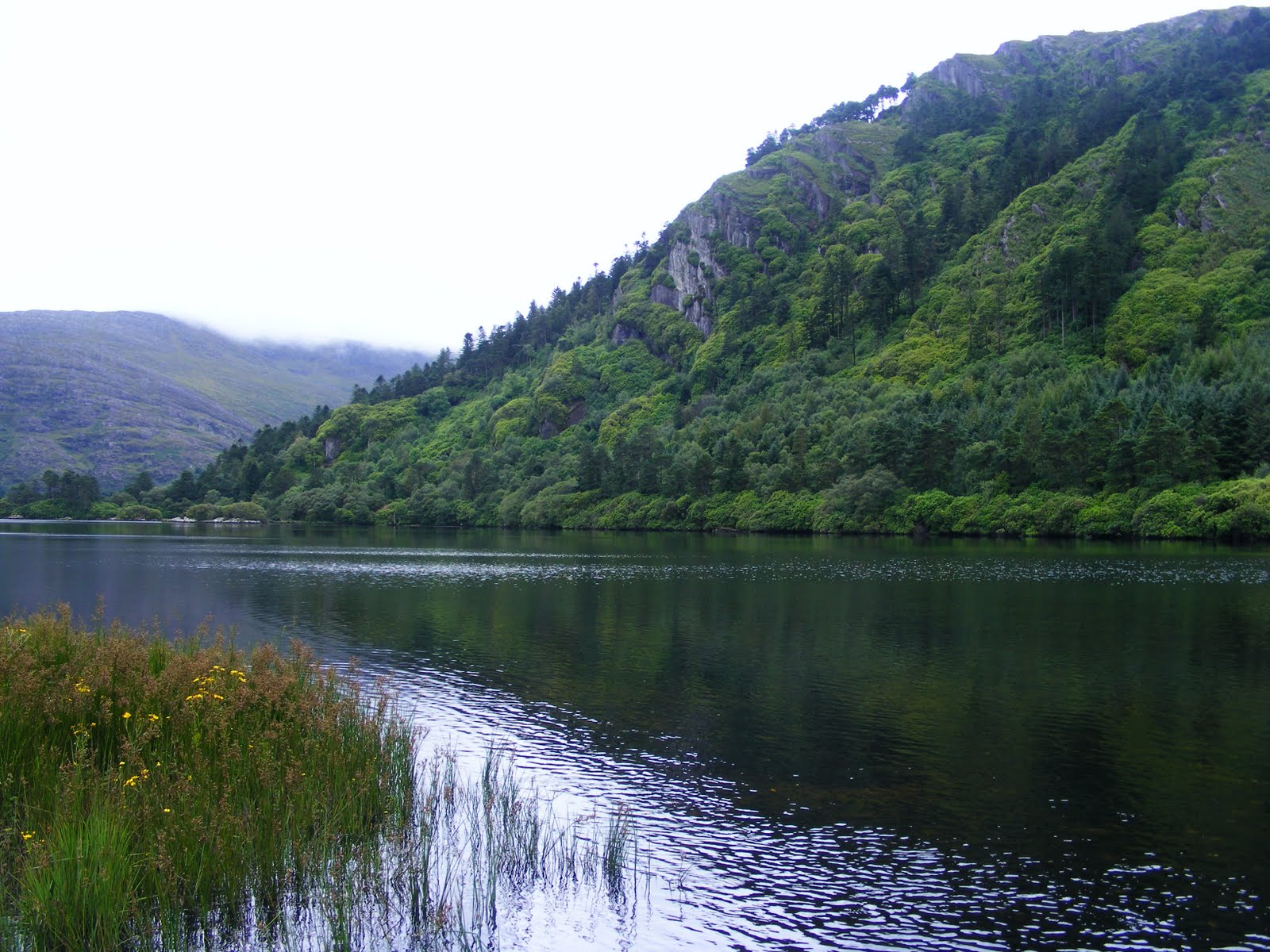
6. The Glanmore River and Lake.


7. Anemones and starfish in a sea-cave.
16 August 2011
Poets Meet Painters Launch
 |
| Photo from anaduncan.com |
I noticed that a lot of the short-list and winners had drawn on their own experiences and memories for their poem but yet had a clear link to the artwork they were inspired by. I think the artwork more inspired reflection and thought on the poets' own experiences than created a new scenario in the poets' minds, which is what I had imagined would happen. But then, the relating of our own thoughts, experiences, and memories is rather the definition of poetry.
The launch of the Poets Meet Painters anthology was a nice event. It was raining, unfortunately, but most of the audience was covered by the tent that was set up outside. Copies of the anthology, water, and wine all seemed to sell very fast. Amazingly enough, everyone was there on time, even early, which the gallery didn't expect. And small wonder, with the Irish sense of time!
What I found most interesting was that the artists of the pieces were there. Last year only a few were in attendance. Ana Duncan said that 'Crest,' and her series of similar works were inspired by the struggle between man and the sea. I found it interesting how I managed to pick up on that with my poem, which details a fishing trip out on the sea. Most of the artists were able to reveal that they had been inspired by similar themes to those that inspired the poets.
This competition and event is growing fast people. I suggest you get writing for next year's competition!
To see more of Ana Duncan's work, her website is here.
For details of the winners, photos, and to purchase the Poets Meet Painters anthology for a measly fiver plus postage, the Hungry Hill Writing Website is here.
13 August 2011
'The Winter of Our Discontent' Book Review
I found this book hard to get through, for a while at least. It didn't seem to draw me in like the rest of Steinbeck's books do. It took about half of the book to get me really involved. The sometimes first person narrative threw me a little, I must admit. The story was good though. I thought it was a little...older in feeling than the others I have read, but it makes sense as it was his last novel.
From the blurb: Ethan Allen Hawley's family has come down in the world. His father's people were prosperous ship-owner sin New Baytown, but Ethan is a clerk in a grocery store...One day the seed of a chance incident blossoms into a fantastic resolution in Ethan's mind. Why shouldn't the mouse sharpen his teeth and join the rat-race? Why shouldn't the honest man use the very quality of steel that has made him honest to cut his way through the competitive jungle? Ethan is armed for his pirate project not only with his reputation but with a great deal of inside knowledge about his customers, the citizens of New Baytown. The winter of our discontent appears to have turned to glorious summer. But though he has proved several superficial truths,he has forgotten a fundamental one: dishonesty is invisibly infectious.
I think the way I read this, in between a myriad of other books, contributed to me not liking it as much as Steinbeck's other novels. I love reading Steinbeck because he is refreshing, and for this book, like the blurb says "he has put his finger on the pulse of a small town." Steinbeck is an expert at showing that though people appear different on the surface, thoughts, feeling, impulses, and urges are the same within.
The Winter of Our Discontent was darker, I thought, than a lot of his earlier work. I enjoyed reading it. As always the characterisation was superb, and New Baytown was described in intricate detail. The plot was more in evidence than in some of his other work, and it was overall an engrossing novel.
I give it:
Which means... four stars
 Amazon listing here.
From the blurb: Ethan Allen Hawley's family has come down in the world. His father's people were prosperous ship-owner sin New Baytown, but Ethan is a clerk in a grocery store...One day the seed of a chance incident blossoms into a fantastic resolution in Ethan's mind. Why shouldn't the mouse sharpen his teeth and join the rat-race? Why shouldn't the honest man use the very quality of steel that has made him honest to cut his way through the competitive jungle? Ethan is armed for his pirate project not only with his reputation but with a great deal of inside knowledge about his customers, the citizens of New Baytown. The winter of our discontent appears to have turned to glorious summer. But though he has proved several superficial truths,he has forgotten a fundamental one: dishonesty is invisibly infectious.
I think the way I read this, in between a myriad of other books, contributed to me not liking it as much as Steinbeck's other novels. I love reading Steinbeck because he is refreshing, and for this book, like the blurb says "he has put his finger on the pulse of a small town." Steinbeck is an expert at showing that though people appear different on the surface, thoughts, feeling, impulses, and urges are the same within.
The Winter of Our Discontent was darker, I thought, than a lot of his earlier work. I enjoyed reading it. As always the characterisation was superb, and New Baytown was described in intricate detail. The plot was more in evidence than in some of his other work, and it was overall an engrossing novel.
I give it:
Plot: ***
Characters: *****
Voice: ***
Originality: ***
Dialogue: *****
Which means... four stars

11 August 2011
The Meeting of the Waters, Killarney
We returned from Kerry last Friday. Along with the Poets Meet Painters launch and award ceremony, we managed to squeeze a lot in.
 This is a postcard from 1917. The scene depicted is the Meeting of the Waters, near Killarney. I thought it would be interesting to see what it looks like today (and take a photo of course). We stopped off and took a short fifteen-minute walk or there about to the Meeting of the Waters (The Meeting of the Waters is the point where the Upper, Middle (Muckross lake) and Lower (Lough Leane) lakes meet).
 It was like foggy memory. There was that recognition and déjà vu of an unexplainably familiar place but the knowledge that I had seen it in a picture and had just never seen it in person. Of course there was also relief that it looked, well, exactly the same. Sure there were changes, the bushes had grown somewhat in the intervening (almost) one hundred years. The boat that passed under the bridge was a motor boat with people hooked into orange life-vests, instead of the row boat on the postcard. There was the fact that the path was right in front of the toilets and the bridge had been "restored" in 2007. But overall there was definitely a sense of continuity.
 Olive writes that they came under the bridge (Old Weir Bridge) during her trip on the lakes and had seen deer along the banks. I witnessed a boat making the same journey and I have stood in the National Park listening to the deer. Killarney and its surrounds have been inhabited for 4,000 years. In 1750 Viscount Kenmare built roads, boating facilities, and inns. Queen Victoria visited in 1861 with her entourage and the first Irish National Park was formed in 1932.
Killarney may have become a huge tumour of hotels and resorts since then but buried underneath its essence is still there. It has a long past that is still tangible. And it has a future.


Killarney may have become a huge tumour of hotels and resorts since then but buried underneath its essence is still there. It has a long past that is still tangible. And it has a future.

27 June 2011
Sky Lantern

We belatedly celebrated the solstice and the end of my exams the other night with one of these sky lanterns. They are cool, rising like miniature hot air balloons. Well, maybe not too miniature, this one was pretty big! They are cheap too, and relatively easy to light and send off. Ours rose fast, even on a night with little wind, so it's probably best to let them off on a windless evening.

I'm currently in the process of moving my WordPress photography blog over to blogger. It's a lot of work, but hopefully when I'm finished it will end up many times easier to navigate (for me and for readers).
We will be heading down to Cork and Kerry and the Millcove Gallery for the Poets Meet Painters award ceremony/publication launch on the 30th of July. We are hoping to spend a week down there hiking in the National Park and exploring the area.
23 June 2011
'Siberia' Book Review
'Siberia,' by Ann Halam, is an intriguing book. It is set in the future, and it only took me until the end of the book to realise that I had read Halam before, in the equally thrilling 'Dr Franklin's Island.' One of the things that I like most about her books is that, though they show a bleak and sometimes depressing world, they end rather happily. Enough to make the reader believe there is hope for the world she has created.
 From the blurb: When Rosita was tiny...she and her mama had to go and live in an ugly place...a prison camp...she didn't understand her mama's magic...She only knew she had to keep the secret until Mama said it was time to start on the great journey...But once Rosita grew up to be a tough, cynical girl called Sloe...Mama was gone. Sloe had to make the journey alone...Sloe becomes a heroine, equal to anything, in this dazzling blend of science, adventure, and fairy tale.
I really enjoyed reading this book. Like the blurb says, it is a mix of science, adventure, and fairy tale. Each element is warped and rearranged to fit with the others but they are no less pure for that. The world as Halam created it was spectacular. I could see everything as though it was before me, and the people fit cleanly into it. It might be true that people will easier believe a big lie than a small one, and that is true here. How odd this book seems, though no less odd than the other I read, but it is...believable. Sloe's love for the tiny animals is real and her adventures as she tries to make it back to her mother are difficult and trying. The other characters are vibrant. I think this was a great book. In fact, I might recommend it on the strength of the note at the end alone.
Halam writes:
The greatest seedbank in the world is held in Lenigrad....In the Second World War...half a million people starved, but the curators of the seedbank barricaded themselves in, and defended their stocks - the hope of the future - from the starving citizens. When Allied soldiers finally entered the facility, they found the emciated bodies of the botanist lying beside full sacks of potatoes, maize and wheat, a priceless genetic legacy for which they had given their lives. This is the story that gave me the idea for Sloe and her adventures...The Siberia I'm talking about in this story is not a place. Siberia is a sate of mind.
I give it:
Which means... five stars

Amazon listing here.

I really enjoyed reading this book. Like the blurb says, it is a mix of science, adventure, and fairy tale. Each element is warped and rearranged to fit with the others but they are no less pure for that. The world as Halam created it was spectacular. I could see everything as though it was before me, and the people fit cleanly into it. It might be true that people will easier believe a big lie than a small one, and that is true here. How odd this book seems, though no less odd than the other I read, but it is...believable. Sloe's love for the tiny animals is real and her adventures as she tries to make it back to her mother are difficult and trying. The other characters are vibrant. I think this was a great book. In fact, I might recommend it on the strength of the note at the end alone.
Halam writes:
The greatest seedbank in the world is held in Lenigrad....In the Second World War...half a million people starved, but the curators of the seedbank barricaded themselves in, and defended their stocks - the hope of the future - from the starving citizens. When Allied soldiers finally entered the facility, they found the emciated bodies of the botanist lying beside full sacks of potatoes, maize and wheat, a priceless genetic legacy for which they had given their lives. This is the story that gave me the idea for Sloe and her adventures...The Siberia I'm talking about in this story is not a place. Siberia is a sate of mind.
I give it:
Plot: *****
Characters: *****
Voice: *****
Originality*****(is six possible here?)
Dialogue: ****
Which means... five stars

Amazon listing here.
Subscribe to:
Posts (Atom)